
Showing posts with label Incentives. Show all posts
Showing posts with label Incentives. Show all posts
Monday, May 23, 2022
Why Shale Drillers Are Pumping Out Dividends Instead of More Oil and Gas

Wednesday, May 4, 2022
How Not to Build Affordable Housing

Monday, May 2, 2022
Biden Establishes a Ministry of Truth

"Put yourself in his shoes. If you predict doom and nothing much happens, it was because of your wise warning. If you don’t predict doom and reality is worse than you predicted, you will be blamed and shamed. The incentives are clear. Truth experts at the DGB will proclaim grave threats around every turn even when any “threats” are minor to nonexistent.
"By creating the DGB, the U.S. government is creating a crisis monitor with the dial permanently set to “existential threat.” No one inside the board will have the incentive—or the courage—to dial it down."
Monday, March 28, 2022
A Wide‐Ranging Book for Non‐Economists and Economists
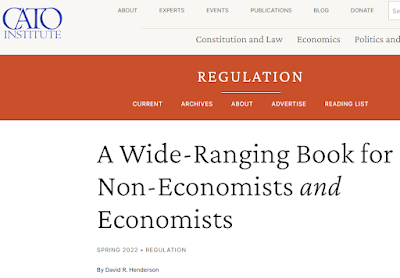
- Opportunity Cost
- Marginalism
- Incentives
- Government vs. Free Markets and
- Safety Information.
Monday, November 1, 2021
Do we want to discourage marriage and work?

.
Thursday, September 9, 2021
Amazon Go

Increases in the minimum wage are not going to slow the replacement of people with machines.
Tuesday, September 7, 2021
New York Trashes Landlords Again

Do restrictions on evictions and increases in rent increase the incentive to become a landlord or decrease the incentive? How would the change affect the future availability of rental housing?
Friday, June 11, 2021
Copper Boom Has BHP, Freeport Picking Through Waste

Saturday, May 15, 2021

Thursday, March 18, 2021

Monday, September 14, 2020
The role of incentives in the CA fires

- Burn bosses don't suffer when they don't order controlled burns, but do suffer when a controlled burn gets out of hand.
- Public ownership of public lands means that no individual has a strong incentive to maintain the land.
- Command and control regulations often have unintended consequences and thwart attempts to perform controlled burns.
Saturday, August 8, 2020
Bill Gates says most tests for coronavirus are "garbage"

"Well, that’s just stupidity. The majority of all US tests are completely garbage, wasted. If you don’t care how late the date is and you reimburse at the same level, of course they’re going to take every customer. Because they are making ridiculous money, and it’s mostly rich people that are getting access to that. You have to have the reimbursement system pay a little bit extra for 24 hours, pay the normal fee for 48 hours, and pay nothing [if it isn’t done by then]. And they will fix it overnight.
"Why don’t we just do that?
"Because the federal government sets that reimbursement system."
Friday, July 17, 2020
What happens when coronavirus makes a plant an unsafe place to work?

- The demand for PPE increased. What do you think happened to prices for PPE?
- The supply of labor decreased; people don't want to work where the probability of getting sick is high. What happened to the price of labor?
- Owners are substituting machines for people to pack meat. Would they substitute more and faster when the price of labor is low or when it is high?
Are the responses by owners what a benevolent social planner would order?
Friday, February 14, 2020
How firms avoid paying tariffs

- What determines whether the US firm moves operations to the US, continues to import from China and pay the tariff, or use a trick to sidestep the tariff?
- Is sidestepping the tariff consistent with the goal of moving operations to the US?
- Are the tariffs increasing the general standard of living in the US?
Friday, December 6, 2019
Incentives in Organ Transplants

"Transplant programs are not evaluated by regulatory agencies to determine how well they use the organ donors available to them. Instead, they are judged primarily on how many of the patients they transplant are alive one year after surgery—an important but limited metric. The emphasis on one-year survival makes transplant programs overly cautious, letting viable organs go unused instead of using organs that they fear might harm their report card."
The essay includes an example. A surgery team turned down lungs that were good but not great matches for Patient A because another Patient B who had received a transplant had recently died. Patient A subsequently died while waiting for a match.
The emphasis on survival rates also reduces the propensity of doctors to transplant organs into patients who are likely to die within a year; e.g., patients who are old and weak and patients who suffer from other life-threatening diseases.
Monday, September 30, 2019
Subscribe to:
Posts (Atom)