Showing posts with label Externalities. Show all posts
Showing posts with label Externalities. Show all posts
Tuesday, August 23, 2022

Tuesday, July 12, 2022
Government Externalities and the Friedman Criterion

Tuesday, June 21, 2022

Monday, March 28, 2022
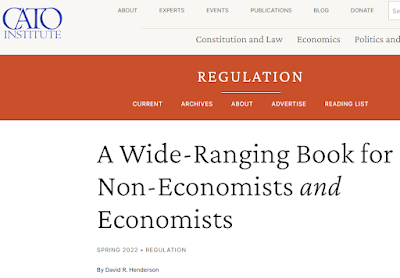
A Wide‐Ranging Book for Non‐Economists and Economists
- Opportunity Cost
- Marginalism
- Incentives
- Government vs. Free Markets and
- Safety Information.
Friday, January 28, 2022
Americans Should Pay More for Gas, Not Less

"Economists point out that the size-based feature gives car companies an incentive to manufacture and sell bigger vehicles: to make fuel economy standards easier to meet. There is no clear mechanism in the rule that works to limit the number of gas guzzlers an auto maker sells. There also are several loopholes, such as credit given for technologies that don’t directly improve fuel economy."
"Taxing carbon emissions or gasoline directly, as Europe does, would be far more cost-efficient. An analysis by Prof. Mark Jacobsen at the University of California, San Diego, showed that the cost per gallon saved through the fuel-economy standard is three to six times higher than a gasoline tax. But raising federal gasoline taxes, which have stayed at an inflation-unadjusted 18.4 cents a gallon since 1993, would be political suicide. Carbon taxes are deeply unpopular, too."
Friday, December 10, 2021
Reducing risks has costs
 What Williams says about safety applies to pollution (Cafe Hayek, Dec. 2021).
Friday, December 3, 2021
Trends in CO2 emissions

Note that a good chunk of the decrease in 2020 is a result of the decrease in driving because of lockdowns declared to slow the spread of COVID-19.

Both charts taken from Carpe Diem
Friday, October 29, 2021
Better than sequestration?

Maybe the best way to reduce global warming is for people to contribute to funds that purchase coal, oil, and gas fields. The government could compel contributions by increasing taxes and using the additional revenue to make the purchases. The government could encourage the contributions by making them tax deductions or credits.
Friday, August 27, 2021
Mask mandate v voluntary exchange

- A mask mandate. Here, the university acts as the ruler and coerces people to wear masks. VCU, where I teach, requires masks in all indoor settings and encourages them outdoors when social distancing is not possible.
- A market for wearing masks. Here, someone pays people to wear masks. Adjustments in the price could increase or decrease compliance. An important question, of course, is, "Who pays the price?" Professors at UT-Austin think that the university should.
Coase discussed the notion that someone should pay someone else to reduce a negative externality when he developed what is now called the Coase Theorem.
Wednesday, July 14, 2021
China to Launch the World’s Largest Emissions-Trading Program

Under the trading program, emitters such as power plants and factories are given a fixed amount of carbon they are allowed to release a year. They can in turn buy or sell those allowances. That pushes emitters to think of controlling and reducing emissions in terms of a market." (WSJ, July 2021)
"It isn’t known how much an allowance, equivalent to 1 metric ton of carbon emissions, will trade for. Based on regional pilot projects in the previous two years, the average price on the national market is expected to be the equivalent of $6.18 to $7.73, Zhao Yingmin, China’s deputy environment minister, said Wednesday.
The starting price is much lower than the roughly $59 to $70 a metric ton in Europe’s emissions trading program and the $55 to $69 a ton in the U.K.’s system. It would put China’s carbon-emissions prices in line with those of a similar program in the U.S."
Saturday, April 24, 2021

Thursday, December 17, 2020

Wednesday, December 9, 2020
The best herd immunity money can buy

Friday, October 2, 2020
What is the best way to reduce carbon emissions?

- What is the best way to reduce carbon emissions?
- Banning gasoline powered cars and trucks.
- Subsidizing green vehicles.
- Imposing a carbon tax. The revenues could flow to the general budget, be earmarked for green initiatives, or be refunded to taxpayers on a per capita basis as a carbon dividend.
- Which of the three options would have a bigger impact on carbon emissions?
- How much will banning gasoline powered cars and trucks in CA, or even in the USA, affect climate change?
- Who loses if drivers pay a tax sufficient to compensate people for the externality they create when they burn gasoline?
- Who loses if a law forbids drivers from purchasing a gasoline-powered car and the drivers are willing to pay a tax sufficient to compensate people for the externality they create when they burn gasoline?
Friday, September 18, 2020
‘Sustainable’ Investing Is a Self-Defeating Strategy

Thursday, August 13, 2020
Alan Blinder discusses masks, public health, and externalities

Saturday, April 18, 2020
Pollution reduces human capital.

Thursday, February 27, 2020

Could geoengineering reverse climate change?

Questions: Can government bureaucrats anticipate all the possible innovations that may help fight climate change? If not, how can they figure out the best way to combat climate change?
Wednesday, February 12, 2020
Two ways to reduce the impact of humans on climate change
 Removing carbon dioxide from the atmosphere is a substitute for reducing emissions at the source (WSJ, Feb. 2020). What would more often result in the efficient choices between the two options, a pollution tax or government officials deciding the "best" way to reduce CO2 in the atmosphere?
Subscribe to:
Posts (Atom)