Monday, August 30, 2021

High Pay for Covid-19 Nurses Leads to Shortages at Some Hospitals

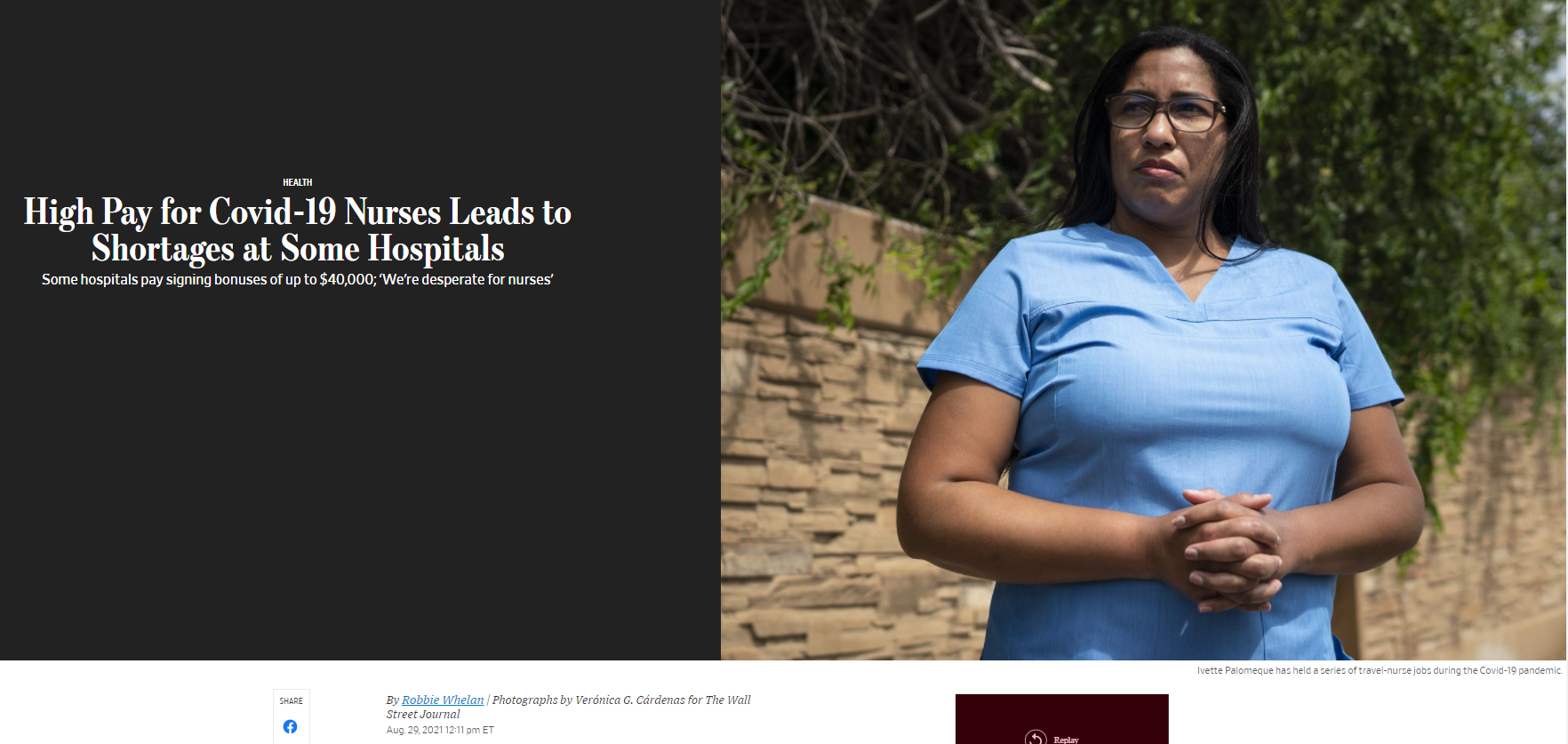
High crisis pay [for temporary travel nurses] is exacerbating a chronic shortage of permanent medical staff across the country, which predates the pandemic and extends to all parts of the healthcare system. Hospital leaders expect their labor crunch to persist long after the pandemic has calmed. (WSJ, Aug. 2021)

  1. What happens to the demand for travel nurses when COVID increases hospitalizations in some area?
  2. Have wages for travel nurses changed as predicted given your answer to Q1?
  3. What happens to the supply of permanent workers given your answer to Q2?
  4. Would the change you describe in Q3 exacerbate the labor crunch for permanent nurses?
  5. What do you predict will happen to wages for permanent nurses given your answers in Q3 and Q4?
  6. "Harris Health said in mid-August that it would raise pay for all emergency-department and adult-ICU nurses to $140 an hour until staffing levels stabilize." Is this increase consistent with your prediction in Q5?

Why rent control isn’t working in Sweden

A shortage of accommodation in Stockholm and other cities, is causing a major headache for young Swedes - in a country which has been championing rent controls since World War Two. (BBC, Aug. 2021)

Friday, August 27, 2021

Mask mandate v voluntary exchange

Professors at UT-Austin may pay students to where masks (Aug 2021). It illustrates two different ways to get people to wear masks.

  1. A mask mandate. Here, the university acts as the ruler and coerces people to wear masks. VCU, where I teach, requires masks in all indoor settings and encourages them outdoors when social distancing is not possible.
  2. A market for wearing masks. Here, someone pays people to wear masks. Adjustments in the price could increase or decrease compliance. An important question, of course, is, "Who pays the price?" Professors at UT-Austin think that the university should.
Coase discussed the notion that someone should pay someone else to reduce a negative externality when he developed what is now called the Coase Theorem.

Wednesday, July 14, 2021

China to Launch the World’s Largest Emissions-Trading Program

"The program will initially involve 2,225 companies in the power sector. Those companies are responsible for a seventh of global carbon emissions from fossil-fuel combustion, according to calculations by the International Energy Agency.

Under the trading program, emitters such as power plants and factories are given a fixed amount of carbon they are allowed to release a year. They can in turn buy or sell those allowances. That pushes emitters to think of controlling and reducing emissions in terms of a market." (WSJ, July 2021)

"It isn’t known how much an allowance, equivalent to 1 metric ton of carbon emissions, will trade for. Based on regional pilot projects in the previous two years, the average price on the national market is expected to be the equivalent of $6.18 to $7.73, Zhao Yingmin, China’s deputy environment minister, said Wednesday.

The starting price is much lower than the roughly $59 to $70 a metric ton in Europe’s emissions trading program and the $55 to $69 a ton in the U.K.’s system. It would put China’s carbon-emissions prices in line with those of a similar program in the U.S."
Monday, July 12, 2021

Coffee Prices Soar After Bad Harvests and Insatiable Demand

Drought in Brazil and port delays in other countries lead the USDA to expect "consumption ... to exceed production this year for the first time since 2017". (WSJ, July 2021)

  1. Does the article describe a shortage or surplus of coffee?
  2. Was coffee scarce before the drought and port delays?
  3. In what sense is demand "insatiable"?


Tuesday, July 6, 2021

Banning Payday Loans Harms Borrowers

Alex Tabarrok reviews a paper in the NBER that finds that most common regulations of payday loans make borrowers worse off. (MRU, July 2021) Here is a money quote.

"It’s no surprise that people who leave free money on the table have planning problems and need to borrow, it’s just that preventing them from borrowing doesn’t make them better off."