- Gary Becker argued that the minimum wage exacerbates the employment disparity between White and Black workers when employees discriminate against Black employees in favor of White employees. A minimum wage greater than the equilibrium wage, creates a surplus of labor and allows employers to discriminate against Black workers without having to pay higher wages to White workers.
- Jason Riley writes that the origin of minimum wage legislation is, in fact, racist (WSJ, Feb. 2021).
- “The federal government got involved in setting wage levels in the 1930s and did so at the urging of unions that excluded blacks as members. During debates in Congress, lawmakers complained openly about the ‘superabundance’ and ‘large aggregation of Negro labor’ and cited complaints by whites of black Southerners moving north to take jobs.
- “As Congress increased the minimum wage periodically over the decades, these same arguments were put forward as a justification. When he was a U.S. senator from Massachusetts, John F. Kennedy backed minimum-wage hikes as a way of protecting New England industry. ‘Having on the market a rather large source of cheap labor depresses wages outside of that group, too—the wages of the white worker who has to compete,’ he lectured an NAACP official at a hearing in 1957. ‘And when an employer can substitute a colored worker at a lower wage—and there are, as you pointed out, these hundreds of thousands looking for decent work—it affects the whole wage structure of an area, doesn’t it?’”
- "We provide a comprehensive analysis of the effects of minimum wages on blacks, and on the relative impacts on blacks vs. whites. We study not only teenagers – the focus of much of the minimum wage-employment literature – but also other low-skill groups. We focus primarily on employment, which has been the prime concern with the minimum wage research literature. We find evidence that job loss effects from higher minimum wages are much more evident for blacks, and in contrast not very detectable for whites, and are often large enough to generate adverse effects on earnings. We supplement this work with additional analysis that distinguishes between effects of an individual’s race and the race composition of where they live. The extensive residential segregation by race in the United States raises the question of whether the more adverse effects of minimum wages on blacks are attributable to more adverse effects on black individuals, or more adverse effects on neighborhoods with large black populations. We find relatively little evidence of heterogeneity in effects across areas defined by the share black among residents." (NBER working paper by David Neumark and Jyotsana Kala)
Wednesday, November 20, 2024
How racist is the minimum wage?

Friday, January 6, 2023
Quartz talks about the benefits of free trade
Here is what Quartz says would happen if the world split into two separate trading blocs.
2.2%: Expected decline in global trade growth in 2022, according to the World Trade Organization
5%: How much global GDP would drop if countries split into two economic trading blocs
1%: Fall in US GDP if this split happened
7%: Decline in GDP for developing nations under the arrangement
43: Countries that Apple sources materials from to build the iPhone
25-30%: Global supply of palladium, a material used in iPhones, that Russia produces
Thursday, September 22, 2022
The West Mimics Mao, Takes a Green Leap Forward

Not everyone is enthused about how governments are pushing green energy.
"One of the essential lessons from China’s Great Leap Forward is that catastrophic failures inevitably follow from politicians’ insistence on ignoring reason, logic, truth and economics. Europe’s current energy crisis, California’s continuing power outages and Sri Lanka’s food shortages are all warning signs. The Green Leap Forward has set humanity on a fast track to another man-made catastrophe." WSJ, Sept. 2022
Another opinion in today's WSJ bemoans the proclivity of Telsa batteries to overheat and catch fire. Who knew?
Success at Work Is Warped by Your Co-Workers’ Salaries

"It was as if simply knowing how the market valued talent made them want to be entirely different people at work. These players couldn’t resist the incentives 'to produce whatever the boss is measuring and rewarding,' as Mr. Card wrote in an email, even if those bosses were measuring and rewarding the wrong numbers." WSJ, Sept. 2022
Wednesday, September 21, 2022
Electric-Car Demand Pushes Lithium Prices to Records
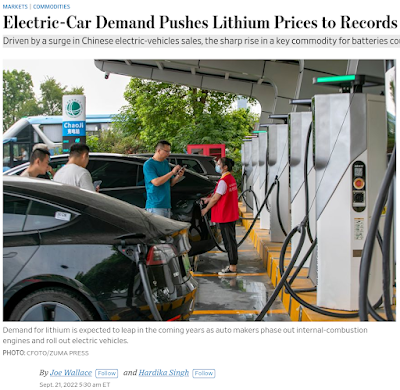
Questions
- How would an increase in the number of EVs affect the equilibrium price and quantity of lithium?
- How would an increase in the price of lithium affect the equilibrium price and quantity of cars?
Monday, September 12, 2022

Tuesday, September 6, 2022

Thursday, September 1, 2022
Are TSA checkpoints worth the expense?

Why does the government require screenings if the cost per life saved is so high?
Can you think of other policies the government could impose that would save lives at a lower cost? Why doesn't the government impose those policies?
Tuesday, August 23, 2022
On Car Seats as Contraception

Friday, August 19, 2022

Wednesday, August 17, 2022
The Minimum Wage’s Racially Discriminatory Roots

“As Congress increased the minimum wage periodically over the decades, these same arguments were put forward as a justification. When he was a U.S. senator from Massachusetts, John F. Kennedy backed minimum-wage hikes as a way of protecting New England industry. ‘Having on the market a rather large source of cheap labor depresses wages outside of that group, too—the wages of the white worker who has to compete,’ he lectured an NAACP official at a hearing in 1957. ‘And when an employer can substitute a colored worker at a lower wage—and there are, as you pointed out, these hundreds of thousands looking for decent work—it affects the whole wage structure of an area, doesn’t it?’”
Saturday, August 13, 2022

Wednesday, August 3, 2022
Supply is Elastic

Question
- Did the people who planned the buy-back hope to increase the production of guns?
- Did the people who produced the 3-D guns response rationally?
- Do you think that the people who produced the 3-D guns sell them in gun shows or on the street? Why or why not?
Tuesday, July 12, 2022
Government Externalities and the Friedman Criterion

Why Studying Economics Requires Curiosity

To my mind, the preeminent intellectual antecedent is curiosity."
"To be a successful student of economics, therefore, one must come ready to understand the world—not to judge it. My experience with teaching Econ 101 suggests that “judging” is the single most relevant barrier to understanding"
Peloton to Stop Making Bikes Itself

D0 economies of scale, specialized investments, and contracting costs suggest that outsourcing or in-sourcing is the best way to acquire bikes and treadmills?
It’s Time to Streamline the Hiring Process
The piece discusses the importance of information flows, decision rights, and incentives in the hiring process.
Atta Tarki, Tyler Cowen, Alexandra Ham, HBR, July 2022
"Here are few measures you can take to nudge your organization in the right direction.
- Reduce the number of interviewers in your process. If you have more than four or five interviewers, chances are that the costs associated with the additional complexity in your process have exceeded the benefits they produce.
- Be explicit about whose decision it is. Steer your organizational culture away from a consensus-oriented approach. Instead, for each role make it explicit whose decision it is, who else might have veto power, and that other interviewers should not be offended if a candidate is hired despite not getting their approval. And then keep repeating this message until most of your colleagues adapt to this new approach.
- Ask interviewers to use numerical ratings when evaluating candidates. We’ve experienced that doing so helps hiring committees focus on the holistic view rather than on one-off negative comments. Having interviewers submit their ratings before getting input from their colleagues will have the further benefit of reducing the chance of groupthink in your evaluations.
- Remove the “Dr. Deaths” from your hiring committee. Track which interviewers turn down the most candidates, and if they are not better at picking good hires, communicate with them that they will be removed from the hiring committee if they don’t correct their behavior.
- Change your culture to reward those who spot great hires, not penalizing those who end up with an occasional poor performer. You can further do this by emphasizing the difference between good decisions and good outcomes. Sometimes a fully logical bet will result in a poor outcome. If needs be, call out those spreading negativism.
"Changing your company’s consensus-oriented hiring culture will not be easy. But the steps listed above can help you gain an edge in your industry by hiring highly productive employees that are overlooked by your competitors."
Myth or measurement: What does the new minimum wage research say about minimum wages and job loss in the United States?

David Neumark,Peter Shirley, Industrial Relations, April 2022
St. Paul’s Rent-Control Backfire

St. Paul’s rent control creates an incentive for developers to build luxury apartments to recoup their construction costs. But builders are also opting to leave St. Paul."
Subscribe to:
Posts (Atom)